

The best eBay price guide is eBay’s own sold data, available with the eBay Product Research tool. Product Research, formerly called Terapeak, provides sold comps, date filters, sell-through rates, and more. For rare and vintage items, WorthPoint can be helpful for historical data. The right price is not what another seller is asking. It is a price supported by actual sales, current demand, condition, competition, and your desired selling timeline — for a deeper breakdown, see How to Price a Product: 7 Simple Steps to Turn a Profit.
Main Takeaways
- Research sold prices and active prices. Active listings show your current competition. Sold comps show what buyers have paid. Both are important.
- eBay Product Research provides pricing data. It offers up to three years of sales history, actual Best Offer prices, trends, and sell-through rates.
- Do not price based on one high comp. Look for the average price of your item based on condition, size, and attributes.
- Use WorthPoint for rare inventory. Its longer sales history can help price vintage, antiques, and obscure collectibles.
- Adjust prices by marketplace. Fees, buyer behavior, and selling strategies vary across platforms.
Quick Comps: The "Sold Listings" Filter
For most resellers, the fastest pricing research starts with eBay Sold Items. You do not need a complicated pricing calculator every time you find a pair of jeans or a vintage jacket. You need to know (1) if people are buying the item and (2) approximately what they are paying.
When sourcing, if you’re wondering if an item is worth picking up, open eBay (or any resale app) and search for the item as if you’re a buyer, but filter to sold listings.
Here, you can get a quick idea of what the item actually sells for. For better results, be specific in your search, including brand, style, size, condition, etc. You also want to look at recent listings, because listings that sold five years ago are not a good indication of current market value.
Be sure to browse. Don’t assume any individual sold listing provides an accurate expectation of what yours would sell for. Scroll through several solds to determine an average range. Sold comps show what buyers have actually paid, while active listings show your current competition.
⚠️ Warning: Standard sold listings have an important limitation. A listing that accepted a Best Offer may display the original asking price with a strikethrough rather than giving you the negotiated sale price. That can make a comp look much better than it actually was. This is where Product Research becomes essential. eBay specifically confirms that the Product Research tool includes the actual price an item sold for even when a Best Offer was accepted.
Another way to do this even faster is with Google Lens. Snap a quick picture, and results will be displayed from major marketplaces, giving you a quick snapshot of resale market value.
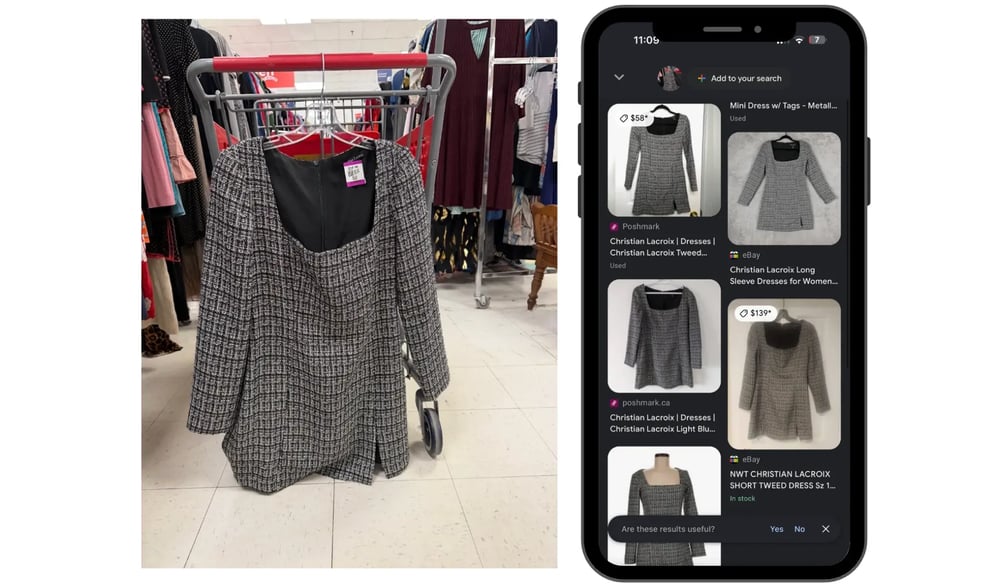
Here, I did a quick Google Lens search of this dress to reveal comps from multiple e-commerce marketplaces. This provides a quick snapshot as to if an item is actually worth buying based on the range it sells for and the cost to you.
Sold listings are excellent for quick, game-time sourcing decisions, but they are only the first layer of pricing research.
Pricing with eBay Product Research, Formerly Terapeak
If you sell regularly on eBay, learn eBay Product Research. This is the tool previously known as Terapeak, and many resellers still call it Terapeak. eBay officially renamed it eBay Product Research and makes it available through Seller Hub and its mobile selling tools.
On desktop, go to Seller Hub > Research > Product Research. The Product Research tool is free to all sellers with access to Seller Hub. You can search by keyword or product and refine your results using filters such as condition, category, brand, color, selling format, location, and other applicable criteria. Most importantly, you can search by date to see active and recent data.
Importantly, the eBay Product Research results contain actual sold prices, including accepted Best Offers.
This matters more than you might think. Imagine an item was listed for $100 and sold after the seller accepted a $65 offer, a negotiation process covered in our Comprehensive Guide to eBay Offers. A standard sold search can leave you thinking that $100 is a valid comp. Product Research gives you the information you actually need to make a pricing decision.
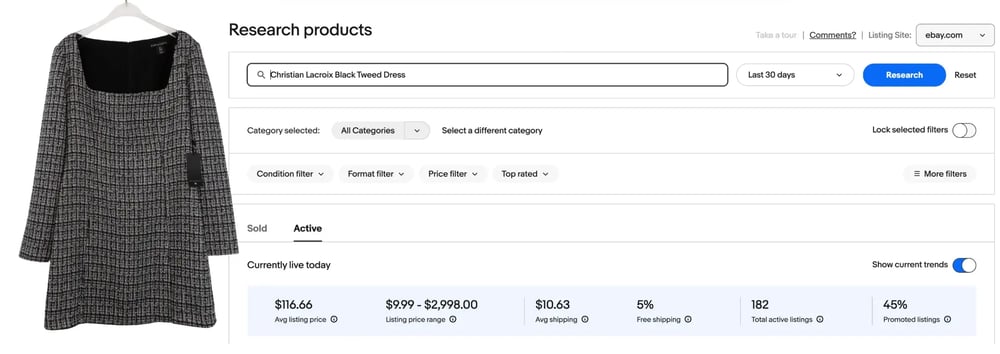
eBay Product Research gives sellers a much broader view of the market than individual comps alone.
For sold listings, eBay provides metrics including total sales, total sellers, total items sold, average sold price, sold price range, average shipping, free shipping percentage, and sell-through rate.
Sell-Through Rates (STR):
Price means very little without demand. Sell-through rate is especially important because it helps put pricing into context. A strong STR indicates healthier demand relative to available inventory, which can give you more confidence about testing the higher end of the realistic comp range. A weak STR tells a different story. If buyers have plenty of competing inventory and relatively few units are moving, an aggressive price can leave your item sitting.
Product Research also lets you examine active listings, which is important because sold comps only tell half of the story. The active data includes metrics such as average listing price, listing price range, average shipping cost, percentage offering free shipping, total active listings, and percentage of promoted listings. This helps you see exactly what you are competing against right now.
Market Trends:
Product Research provides up to three years of eBay sales data, and eBay allows sellers to select custom date ranges within that period. You can also change the timeframe to examine more recent activity, such as the last 30 or 90 days. This is helpful because an item’s historical average is not necessarily representative of what is happening in the market today.
Use the data to look for patterns rather than focusing on one number. Compare average sold price with the current average listing price. Look at the sold price range to see how widely prices vary. Check the number of active listings to understand your competition, and consider shipping costs because a $40 item with free shipping is not necessarily comparable to a $40 item with $12 shipping.
The trend data can also show you where the market is heading. If demand and sold prices are strengthening, you may have room to test a higher price. If average prices and sales volume are falling while active inventory is growing, holding out for last season’s comp may be a mistake. Seasonal products deserve extra attention because a change in price or demand can reflect the calendar rather than a permanent change in value.
The goal is to look at the whole market: what has sold, what it sold for, how frequently it sells, what is currently available, and what competing sellers are charging. This is what makes Product Research much more useful than simply asking, “What did one of these sell for?”
When pricing, don’t forget about Seller Fees. Check out Vendoo’s eBay Fee Calculator!
When to Use WorthPoint for Pricing Vintage and Antiques
Sometimes eBay Product Research does not have enough history. This happens frequently with vintage clothing, antiques, discontinued pieces, unusual ephemera, rare collectibles, and true one-of-a-kind inventory.
eBay’s Product Research tool only provides up to three years of sales history. Standard completed listings are even more limited, covering recently sold items within the previous 90 days. If you have something obscure that last appeared on eBay five years ago, neither search is going to give you that old transaction.
That does not mean the item has no value. It means your research has reached the limit of eBay’s available history.
The WorthPoint Advantage
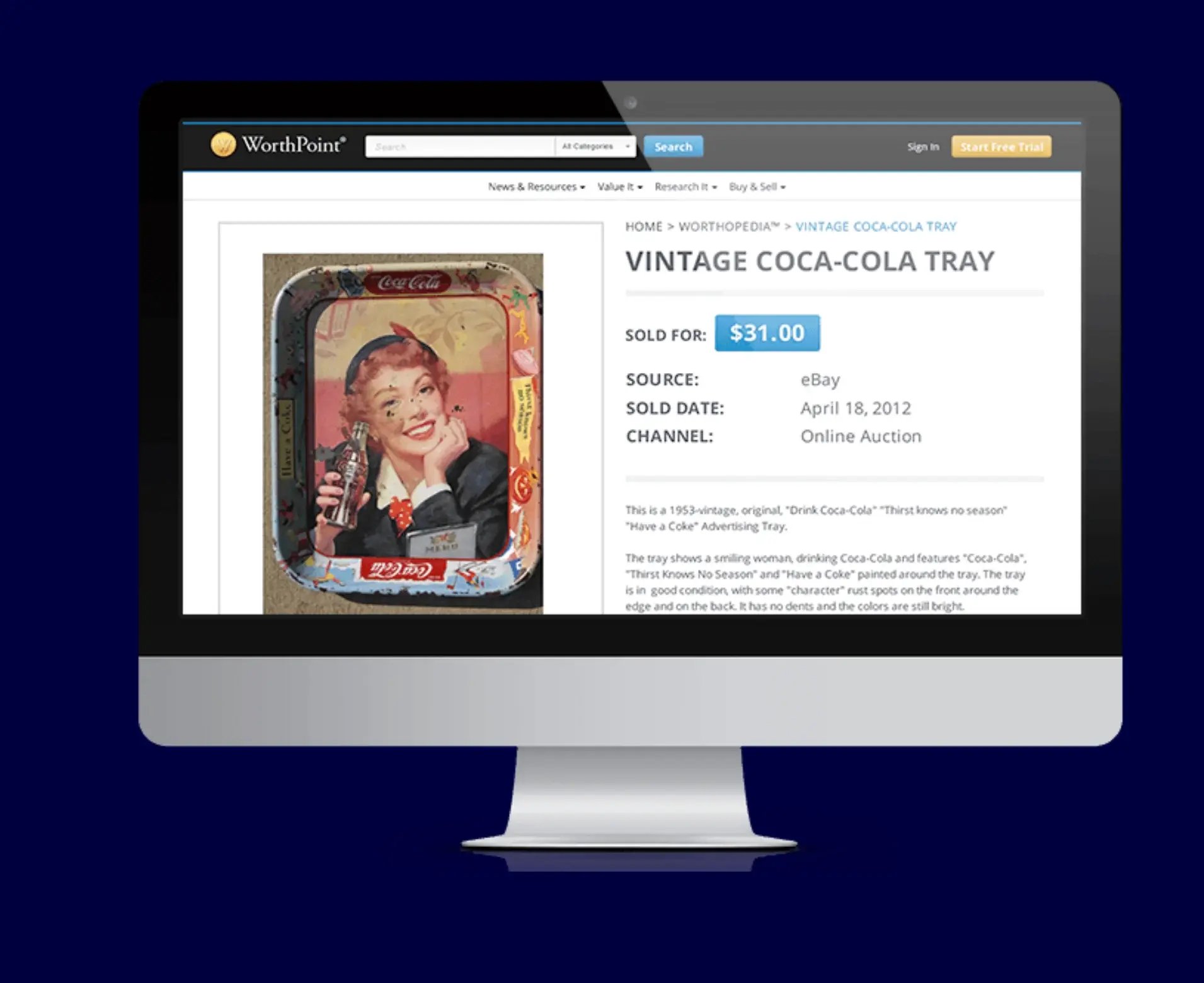
Image Source: WorthPoint
WorthPoint is particularly useful for obscure vintage, antiques, art, and collectibles because its historical pricing database extends back more than 15 years and incorporates records associated with eBay and auction houses. That longer history can uncover comps for items that appear for sale only occasionally.
For a common pair of modern Levi’s, I would not pay for a historical database just to find a comp that eBay can give me for free. For an obscure vintage label, rare advertising piece, antique, or collectible with no meaningful recent sales, WorthPoint becomes much more valuable.
💡 Tip: Old comps are a nice guide, but the market changes. A collectible that sold for $300 ten years ago is not automatically worth $300 today. Use historical sales to establish rarity and past demand, then compare that information with the current market.
Comparison Table: eBay Pricing Research Tools
Each tool serves a different purpose, so the best choice depends on how common the item is and how much historical data you need.
eBay Product Research is more than enough for most sellers. But those selling rare, vintage, and collectible items, might consider WorthPoint.
Centralizing Your Pricing Strategy Across Marketplaces
Finding the right comp is only half of the pricing process if you crosslist. The same item does not necessarily need the same price everywhere.
Adjusting for Platform Fees
A $50 eBay price might become $60 on Poshmark if you are trying to protect your margin against Poshmark’s 20% seller fee. That said, marketplace fees should not impact pricing too much, because an item’s market value does not change just because the seller makes less on a sale.
Vendoo makes marketplace-specific pricing easier because its marketplace forms allow you to customize listing information for each platform instead of treating every marketplace identically. You can keep your inventory centralized while adjusting individual marketplace forms when a different price makes sense.
This is important because your list price is not your profit. Cost of goods, marketplace fees, promoted listing expenses, shipping costs paid by the seller, discounts, and accepted offers can all affect your actual return.
Instant Price Drops
Some sellers raise prices a bit to account for offers and price drops. Stale inventory sometimes needs a pricing adjustment, but there is an important distinction in how Vendoo currently handles live listings.
Vendoo allows sellers to bulk edit listing prices across marketplace forms, including decreasing prices by a percentage or dollar amount. Those edits do not automatically change an already-published live listing. To push the edited pricing live through Vendoo, sellers can use the Bulk Delist and Relisting tool which applies the edits during the delist/relist process.
That still saves substantial time when you have stale inventory listed across eBay, Mercari, Depop, and other marketplaces. Instead of rebuilding each listing individually, you can manage pricing changes centrally and relist the updated inventory across the marketplaces you select.
Flawless Sale Detection
Crosslisting creates one major inventory risk: selling the same one-of-one item twice. Vendoo’s Sale Detection and Auto Delist feature is designed to address that problem. Vendoo offers automatic detection of sales that occur on eBay, Poshmark, Mercari, Depop, Whatnot, and removes item that sell from all marketplaces upon sale. When Vendoo detects a supported sale, it changes the listing status to sold and automatically delists the item from the remaining marketplaces.
That is especially valuable when you price an item aggressively to encourage a quick sale. The more places an item is listed, the greater your exposure, but your inventory management needs to keep up.
How to Price Items on eBay in 2026
The best eBay price guide is not one magic number. Compare active listings with sold comps, use eBay Product Research when you need exact Best Offer prices, sell-through data, trends, and deeper history, and turn to WorthPoint when rare inventory falls outside eBay’s three-year window.
Then price according to demand, condition, competition, fees, and your desired selling speed. Good pricing means using real market data to determine what buyers are likely to pay while considering the inventory you are currently competing against.
Do you have any tips for pricing on eBay? Share in the comments 👇🏽
eBay Price Guide FAQ
How do I find the value of an item on eBay?
use eBay Product Research, which provides up to three years of sales data, STR, sold comps, active comps, and actual accepted Best Offer prices.
Is eBay Product Research free in 2026?
Yes. eBay Product Research is free to all sellers with access to Seller Hub. It was previously known as Terapeak Product Research.
How far back do eBay sold listings go?
Standard eBay completed-listing results include recently sold listings within the previous 90 days. Product Research provides a much deeper history, allowing searches across the last three years. Sellers can also select specific date ranges within that period.
Does eBay show accepted Best Offer prices?
Regular sold results may not reveal the actual amount paid after a seller accepts a Best Offer. Product Research shows data based on actual sale price, even when an offer is accepted.
Should I price my item at the highest eBay comp?
Usually, no. Review multiple sold comps to determine the average selling price, paying close attention to condition, size, color, style, model, and other relevant attributes. Then compare active listings to see your current competition and decide where your item reasonably fits within the market.